
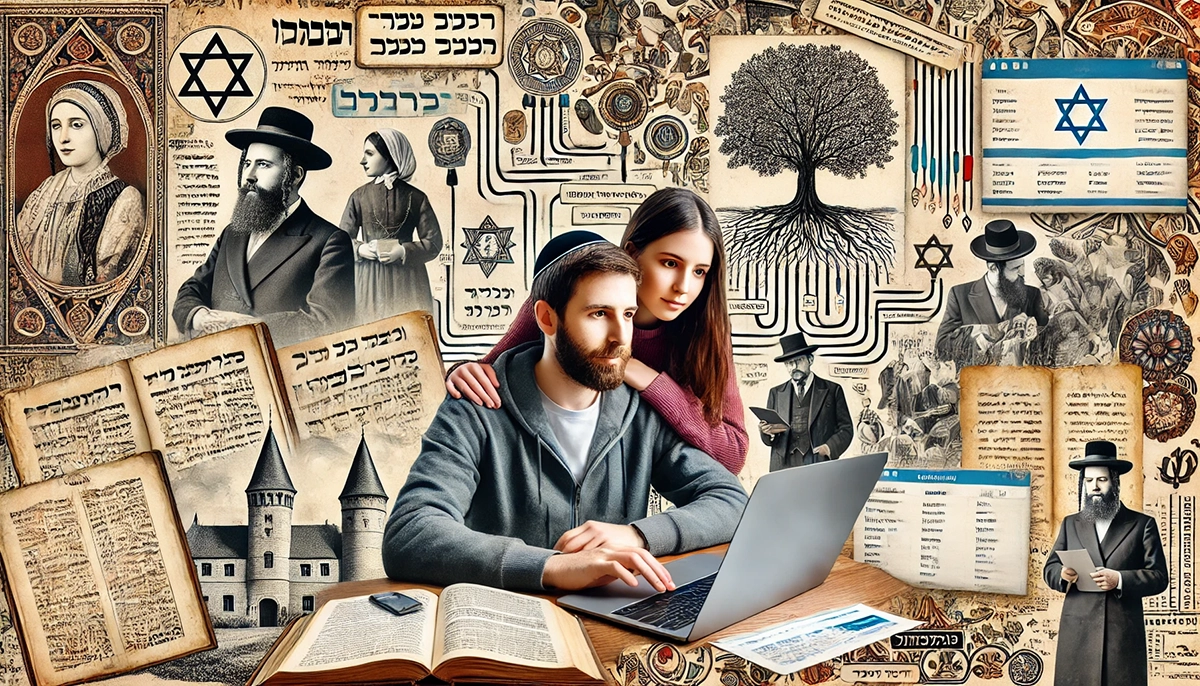
Family history often begins with a simple question: where were our grandparents born, why did they move, and which customs survived at home? For some people, researching Jewish ancestry is a way to understand their family; for others, it raises questions about religious identity or a possible move to Israel. These are related but distinct matters. A family tree can illuminate the past without automatically establishing religious or legal status.
Contents
How to begin researching Jewish roots
Start with details you can establish: full names, maiden names, dates, birthplaces, family relationships, and addresses. Ask older relatives about places where the family lived before migration, languages spoken at home, and the spelling of surnames in older documents. A family story may provide a useful lead, but it needs to be checked against records.
Keep a note of original spellings when possible. A family name may appear differently in documents from the Russian Empire, Poland, the Soviet Union, Germany, Israel, and elsewhere. A changed spelling is not necessarily evidence of a different person, but identical names are not proof that two records belong to the same individual either.
Approach every discovery carefully. A historical register can contain errors, and a shared surname does not establish a family relationship. The stronger your chain of independent documents, the more confidently you can reconstruct a family history.
Why family history can matter to Jewish identity
Identity takes different forms. Someone may have grown up in an observant family; someone else may first learn about Jewish relatives as an adult. Religious practice, language, memories, culture, holidays, and a connection to Israel may matter differently to each person.
You do not need to turn a personal search into a test. Reading letters, learning about ancestral communities, or tracing relatives can be meaningful even when some questions remain unresolved. At the same time, a personal sense of Jewish belonging is not identical to the formal criteria applied by religious authorities or government agencies.
Jewish ancestry, religious status, and aliyah eligibility
Genealogy investigates family relationships and historical evidence. Religious recognition of Jewish status depends on the standards and processes of particular religious authorities or movements. Eligibility for aliyah or citizenship in Israel is a separate legal and administrative question governed by the applicable law and official procedures. These categories overlap in some circumstances but should never be treated as interchangeable.
A family photograph, online database entry, or DNA result does not in itself guarantee recognition of Jewish status or a right to immigrate to Israel. Legal and administrative requirements may change. Consult current official sources and the relevant authorized bodies for guidance about your circumstances.
A dating website cannot certify ancestry and is not a substitute for a genealogical archive, a rabbinical authority, or a government office. Dating should not be used as a means to obtain proof of someone's heritage.
First steps in family research
Talk with relatives
Ask about names, birthplaces, schools, occupations, military service, migrations, and family celebrations. With permission, record memories so that details are not lost. Be sensitive: war, persecution, displacement, and family loss may remain painful subjects. Someone's unwillingness to discuss an event should be respected.
Gather documents at home
Birth and marriage certificates, old passports, letters, family photographs, cemetery inscriptions, and notes written on the backs of pictures can provide dates and connections. Photograph or scan records, record where they came from, and store originals safely. Keep a separate note of details that are uncertain or contradictory.
Create a simple family tree or table
For each person, record known name variants, dates and places, parents, spouses or children, and the source of each fact. Mark assumptions clearly rather than presenting them as established relationships. A modest table with good citations is often more useful than an elaborate tree full of guesses.
Account for changing borders and place names
A town may have belonged to several countries over the last century, and its name may appear in different languages or alphabets. Search historical names, transliterations, and alternate surname spellings. Knowing the former administrative district can help identify the correct archive.
Archives, databases, and useful resources
JewishGen
JewishGen provides resources devoted to Jewish genealogy, including historical records, community information, surname searches, and research guidance. Begin with a known town or relative and read the description of each collection to understand what it contains and what it cannot prove.
Yad Vashem
Yad Vashem preserves and publishes material related to the Holocaust, including records and testimony about victims. Its collections may help reconstruct relatives' experiences or identify family connections. The absence of a person from a particular searchable collection does not prove that an event did not occur.
FamilySearch
FamilySearch offers genealogical records and tools from many countries. The available collections and access conditions vary by location and period. Compare each result with other evidence, especially when names and dates are common.
Local and regional archives
National, municipal, synagogue, community, and cemetery archives may hold relevant material. Check the history of a place, the language in which records were created, and the archive's rules for access or inquiries. In some cases, a qualified local archivist or genealogist can help interpret an unfamiliar record.
Which organizations can help, and with what?
Not every Jewish organization provides documentary verification of ancestry. For example, JDC is known for humanitarian and community work, while HIAS works with people affected by displacement and migration. Their mission should not be confused with issuing a religious determination or a government immigration decision.
If you need recognition of Jewish status for a religious purpose, consult the relevant religious authority. For aliyah and immigration procedures, use the current guidance of the appropriate government and authorized agencies. An older article or a family rumor cannot substitute for an official assessment.
Before hiring a professional genealogist, ask which archives they will search, what documentation they will provide, and how they distinguish confirmed findings from hypotheses. Responsible research shows its sources and level of certainty rather than merely offering an attractive family story.
If you want to explore your own relationship with Jewish heritage, keep that search distinct from judging another person's identity. For the dating side of the conversation, see how identity and life experience shape new relationships.
How family roots can become part of a dating conversation
Family stories can be natural subjects when two people are getting acquainted. They may share memories of grandparents' hometowns, holidays, languages, old books, or moves between countries. These details can create cultural recognition even when their lives have been very different.
Someone else may view Jewish identity or religious practice differently. Avoid demanding documents during early conversations or testing whether a person is “Jewish enough.” Respect for privacy matters more than satisfying curiosity.
On MeetMazal, you can meet people interested in Jewish heritage and relationships. A shared family story may provide a starting point, but it does not guarantee romantic compatibility or confirm anyone's status for religious or legal purposes.
Practical questions instead of unverified family stories
If you have old photographs or letters, ask relatives who appears beside a grandparent, which language was used in a letter, and when the family changed a surname or moved. Such questions often reveal the next useful lead. Do not publish stories as established fact unless the underlying evidence supports them.
With a new acquaintance, lighter questions may be more appropriate: “Which cities did your family come from?”, “Which holidays did you celebrate as a child?”, or “Is there a family story you enjoy telling?” Everyone has the right to decline questions about ancestry or identity.
How to preserve your findings
Record complete links to archival entries, dates of access, collection names, and document numbers. Keep backups of scans and research notes. Do not publish private information about living relatives without their permission. If you contribute to a public database, read its privacy and reuse conditions first.
Researching your ancestry is a way to learn about the past. Dating is an opportunity to get to know a person in the present. Both can matter deeply, but each deserves its own honest purpose.
Leave a Comment